
The blue frontier

What you’re looking at is not a concept. It’s a system beginning to wake up.
These are Ebbing Tides kelp nodes, built on Mecal scour stones originally designed for offshore wind farms. What was engineered as inert infrastructure is now covered in native Dutch kelp, Saccharina latissima.
One single node already tells an entire story.
Structure becomes habitat.
Fish like Pholis gunnellus move in. Eggs are laid. Life organizes itself around form. In just five months, a dead surface becomes a living system. We deployed these nodes across three locations along the Dutch coast. A small beginning. But enough to tell a much larger story that needs telling.
Convergence
We are entering a transition that doesn’t ask for permission.
Three forces are converging.
Planetary overshoot.
We are demanding more from the system than it can regenerate.
Deglobalization.
Efficiency is losing to resilience. Dependence is becoming risk.
Technological acceleration.
What used to be impossible is now becoming operational. With it comes the good, the bad, and the ugly.

Together, these three forces point in one direction. That of a MAJOR transition. Not as a choice, but as a consequence.
We must produce more ourselves, because dependence has become a liability.Yet the systems we rely on are already strained, and simply producing more is no longer an option. This tension will define the decades ahead.
The rule of our time is simple, and it does not bend:
We need more local output, while having less impact.
That is not a small improvement. It is a fundamental tension at the heart of how we produce. A challenge so large, it can only be solved by large solutions.
This is where the ocean enters the picture.
How the ocean could give us a second chance
On land, we have ignored this tension for too long time by simply ignoring it.
We built systems that maximize output while externalizing damage. Soil depletion, water pollution, biodiversity loss, all pushed outside the boundaries of the system that benefits from them. Globalization was, and still is, a key driver that allows for this externalization. We can preserve our western lifestyle because we can tap into the carrying capacity of other regions in the world.
It worked, for a while. Some 400 years, give or take.
But this modus operandi does not scale indefinitely. It scales until we reach the planetary boundaries, and shocker, those boundaries have been met.
We would need the carrying capacity of multiple planets to maintain our standard of living in the way western society has.

This image doesn’t just reveal the trap. It shows the exit.
We’ve been trained to shrink our footprint. Fly less, drive less, buy less. But what if this is just part of the solution? What if the real move is to increase the carrying capacity of the planet as well.
The ocean is not an escape from this problem.
It is a second chance.
Not because the ocean is empty, but because it has not yet absorbed the patterns that defined the agricultural revolution 10,000 years ago. On land, production became fixed, controlled, and optimized around stability and yield. At sea, these patterns are luckily still largely absent. Infrastructure, production systems, and our relationship with the ocean remain fluid, not yet locked into a single dominant logic.
What if we could increase the carrying capacity of our planet through the oceans?
To understand what is at stake, it helps to look back at our evolution.
On land, humanity went through a fundamental transition. The agricultural revolution. We stopped following systems. We started gradually shaping them. Our need for control was central to this shift in relationship with nature.
Agriculture allowed us to stabilize food production, build settlements, and eventually create civilizations. It is one of the most powerful shifts in human history, in the history of this planet even. But it came with a hidden cost. To make agriculture scalable, we needed more control, and in order to have more control we has to simplify the desired ecosystems. We selected for yield, reduced diversity, and gradually built systems that depend on control, inputs, and extraction.
What began as shepherding, became regenerative agriculture, turned to cultivation, and in recent years it slowly became industrialized production.
And with it came a pattern: optimize output, externalize negative impact.

Industrial harvest at scale, where land becomes output through precision and repetition (NDSU).
At sea, Things could not be more different. We are still mostly in the pre-agricultural phase.
Fisheries are, at their core, still a form of hunting and gathering. We search, we catch, we extract. Fishers simply spend a lot of money on very fancy fishing rods.
Their technology has made hunting more efficient. Sonar, GPS, large-scale vessels, global logistics. These tools did not fundamentally change the relationship. They simply reduced the uncertainty of hunting and increased the scale of gathering.
The language reflects this confusion.
Fishers speak of “harvesting” fish, as if they are collecting something that has been grown. But in reality, most of it is still extraction from wild populations. It is gathering, not cultivation.
And that matters.
Because it means the ocean has not yet gone through the same systemic shift that land has.

We learned to cultivate on land. At sea, we still operate as hunter gatherers (with the emphasis on gathering (fultonfishmarket).
Now, for the first time, we have the tools to make that shift.
We are starting to produce in the ocean. Not just take from it.
Seaweed cultivation, shellfish systems, integrated offshore production. These are early signals of a deeper transition. A move from extraction to cultivation.
But here is the danger.
If we simply copy agriculture, we also inherit its shadow. So the question is simple:
Can we produce from the ocean in a way that improves the system it depends on?
Because agriculture did not only create abundance. It also created depletion. The same logic that allowed us to feed billions also drove monocultures, soil degradation, nutrient runoff, and loss of resilience. Industrial agriculture became viable by simplifying complexity and pushing costs outside the system.
If that logic is applied to the ocean, the outcome is predictable.
If we push for more. And in that push, we begin to wear down the very foundation that allows it we will deplete a system that is already strained. From here on, every action we take reverberates and we will pay a price for every mistake we make.
Scary? Definitely. And yet, there is something interesting hidden in this tension. As the great Dutch Johan Cruyff once said:
Every disadvantage has its advantage.
We can no longer limitlessly expand like we have done in the past 200 years. Degraded systems have lost much of their buffering capacity. They respond faster, and more visibly, to what we do. The boundaries come to the surface and that is a dangerous tension to be in. We have to use all our wit, skills, tools, and knowledge within the boundaries of a clearly defined planetary system.
Our near future is less Star Trek, and much more Formula 1.
So what is the Cruyff advantage I was talking about? Well...this tension comes with an edge.
The distance between action and consequence is shortening because of degrading buffering capacities. What once took decades to reveal itself can now become visible within months. If we measure well, this sharpens our feedback loops. Each intervention becomes a signal. Each outcome becomes data.
And for the first time, we can begin to read ecosystems not in hindsight, but more in real time. That is an advantage. Thank you Cruyff.
This is why the ocean is a second chance for us.
Not to repeat agriculture. But to redesign it, using these short feedback loops to our advantage.
To move directly from extraction to regenerative production. To skip the phase were short term efficiency overrides resilience.
However, this requires a different mindset.
Not control over ecosystems, but collaboration with them. Not simplification, but integration. Not maximizing yield at any cost, but designing systems where yield and health reinforce each other.
If we replicate the land model, we repeat the same mistake. Only faster, and at a larger scale.
So production at sea must follow different rules. Less harmful is simply not ambitious enough. What we need is net-positive.
This is where the real shift begins.
For a long time, “sustainable” meant doing less damage. Reducing impact. Slowing degradation. It was a defensive posture. Logical in its time, but not sufficient.
Net-positive asks something else. It asks whether production can actively improve the system it depends on.
That changes everything. Because it means production and ecology can no longer be treated as separate domains. Not as opposing interests. Not as trade-offs to be negotiated.
Nature and production have to converge.
In a net-positive system, infrastructure is not neutral. It becomes part of the living environment.
Energy systems do not only generate electricity, they create physical structure in an otherwise dynamic and often featureless environment. Those structures can host life, alter flows, and become anchors for ecological development.
Ecosystems, in turn, are not passive recipients of protection. They become active contributors.
They stabilize sediments, buffer energy, cycle nutrients, create habitat, and increase the overall resilience of the system. They reduce risk for infrastructure while increasing biological productivity.
Production is no longer layered on top of nature. It is embedded within it.
Kelp cultivation is a clear example of what this can look like when designed well.
If treated as a conventional crop, it risks following the same path as agriculture on land. Annual cycles, optimization for yield, intentional simplification of the system. If you look at most seaweed farms around the world, they often still operate within this limiting belief.
But if approached differently, it opens another direction.
Perennial systems, sometimes described as sea foresting, shifts the logic.
Instead of resetting the system each year, you allow structure to persist. Kelp is not just grown, it becomes part of a continuous living matrix. Over time, this creates vertical habitat, increases spatial complexity, and supports a wide range of species.
Fish use it as nursery grounds.Invertebrates attach and feed.Microbial communities develop.
The system thickens.
At the same time, biomass is produced. Not instead of ecology, but because of it.
The same structure that supports biodiversity is the structure that generates feedstock. Food, materials, biochemicals. Production emerges from a functioning ecosystem, not from its simplification.

How could this look like for the fishing industry?
Fishers could shift from extraction alone to stewardship, by investing in regenerative ocean practices that rebuild the very systems their livelihoods depend on. By deploying structures such as seaweed farms, reef substrates, and habitat corridors, they can enhance biodiversity, create nursery grounds, and stabilize ecosystems. These living systems do not compete with fishing, they amplify it, increasing fish stocks over time while generating additional value through ecosystem services. This is the path toward net-positive fishing: where each season leaves the ocean richer, more abundant, and more resilient than before. From symbols of decline to symbols of renewal, fishers can redefine their role at sea.
This is the key inversion.
In extractive systems, productivity increases as ecosystems are reduced. In regenerative systems, productivity increases as ecosystems increase.
Of course there is a responsibility for the nature builders. Design matters.
Density, spacing, species selection, interaction with currents, nutrient flows, and surrounding habitats all influence whether a system becomes regenerative or extractive. The difference between a living system and a simplified production field can be subtle in the beginning, but profound over time. This is why net-positive is not a label. It is a design discipline.
It requires asking different questions:
Does this system increase ecological complexity over time?
Does it improve the conditions for other species?
Does it strengthen the physical and biological resilience of the environment?
If the answer is no, it is not net-positive, no matter how efficient it appears.
So this is not a trade-off. It is not a negotiation between economy and ecology.
It is co-design.
A way of building systems where production and life are not in conflict, but in alignment. And this is where the opportunity becomes real. Because if we get this right, we are not just producing differently. We are changing the direction of the system itself.
The North Sea is already beginning to show the first signs of what this could look like.

Offshore windmill park along the Dutch coast (architectenweb)
Offshore wind emerges as the first layer. It brings structure, logistics, and energy. Around it, other functions begin to attach. Monitoring, production, ecology, security. What used to be separate sectors starts behaving as one interconnected system.
The sea is not becoming a collection of industries. It is becoming a system.
A system where energy, food, data, ecology, and security are interdependent layers. Where disruption in one layer propagates through the others. Where value is created through integration, not through isolated optimization.
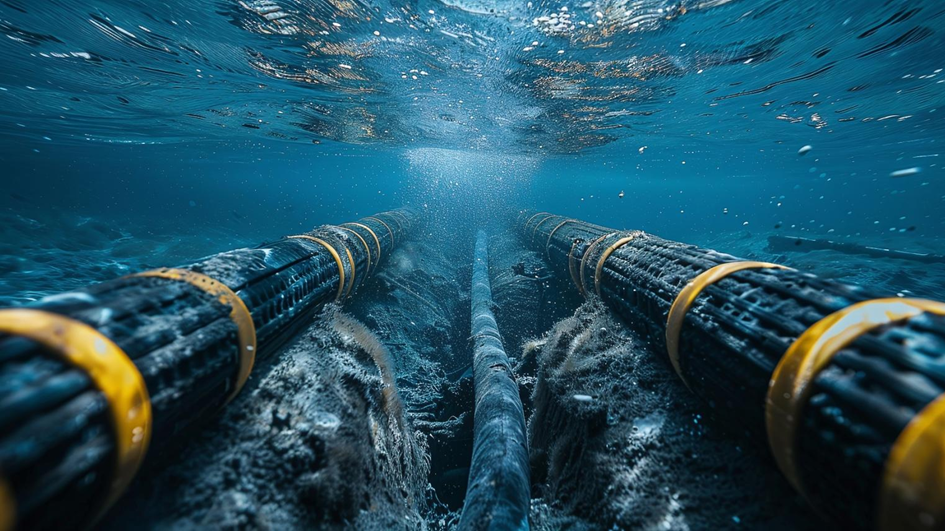
Critical underwater infrastructure (NSC.edu.au)
This is where the real frontier lies. Not further into the ocean, but deeper into system design. The challenge is not to find space. The challenge is to design relationships.
This also reshapes the role of humans.
We cannot approach the ocean as an empty canvas onto which we project everything that no longer fits on land. The system is too dynamic, too interconnected, too responsive.
What is required is a different posture.
Not the exploiter who extracts. Not the optimizer who isolates.
But the one who understands system behavior. Who intervenes without destabilizing.Who uses nature to produce for us, but more importantly, for herself as well.
The ocean as a frontier is not a geographic expansion. It is a systemic shift,
It is a philosophical one.
It is about learning how to produce within limits without pushing those limits further. How to build autonomy without creating new fragilities. How to deploy technology without undermining the underlying system.
Once that becomes clear, the question changes drastically:
Not: what can we take from the ocean?
But: how can we build productive natural systems that produce for us and itself?
Now take a moment and look at the following picture that shows kelp and herring eggs.

Figure 5; A Kelp blade covered in herring eggs collected around Vancouver Island Canada (Seagardens.net)
The world of net-positive production is not theoretical. We’ve already found eggs in our little kelp forests, and on Vancouver Island they already collect herring eggs in purposely designed kelp forests.
Now imagine that system, purposely designed. Not left to chance, but intentionally built. Not as restoration alone, but as way of net-positive production.
That is our next step.
And we are much closer to this reality than we think.
This document was created in partnership with an AI system that served as an ideation engine, a thinking companion, and an editor capable of helping me express complex ideas with clarity and force. It accelerated connections that would have taken me weeks if not months to uncover alone, acting as a catalytic lens rather than a replacement for my judgement. Every concept, argument, and conclusion reflects my own intent and conviction. I stand behind the message, and the direction that comes with it. Mistakes are always part of the process of pioneering, and so are these hypotheses. If you see mistakes that you want to see rectified, please contact me and we will discuss whether the rectification is necessary.


Bài viết của bạn khá súc tích, đọc một mạch là nắm được ý chính nên mình thấy rất dễ theo dõi, cảm ơn vì đã chia sẻ. Mình cũng hay xem thống kê XSMB hằng ngày, nhưng trước đây phải mở nhiều chỗ để đối chiếu nên hơi tốn công. Sau đó mình thử tự tổng hợp lại để tiện xem lại nhanh, và thỉnh thoảng mình ghi chú thêm ngay trên soicau247.com cho đỡ quên. Cách này giúp mình đỡ mất thời gian tìm kiếm mỗi lần cần kiểm tra số liệu theo ngày. Nếu bạn nào cũng có thói quen theo dõi thường xuyên thì có thể xem qua ở đây: https://soicau247.com/thong-ke-xo-so-mien-trung-tk-xsmt.html.